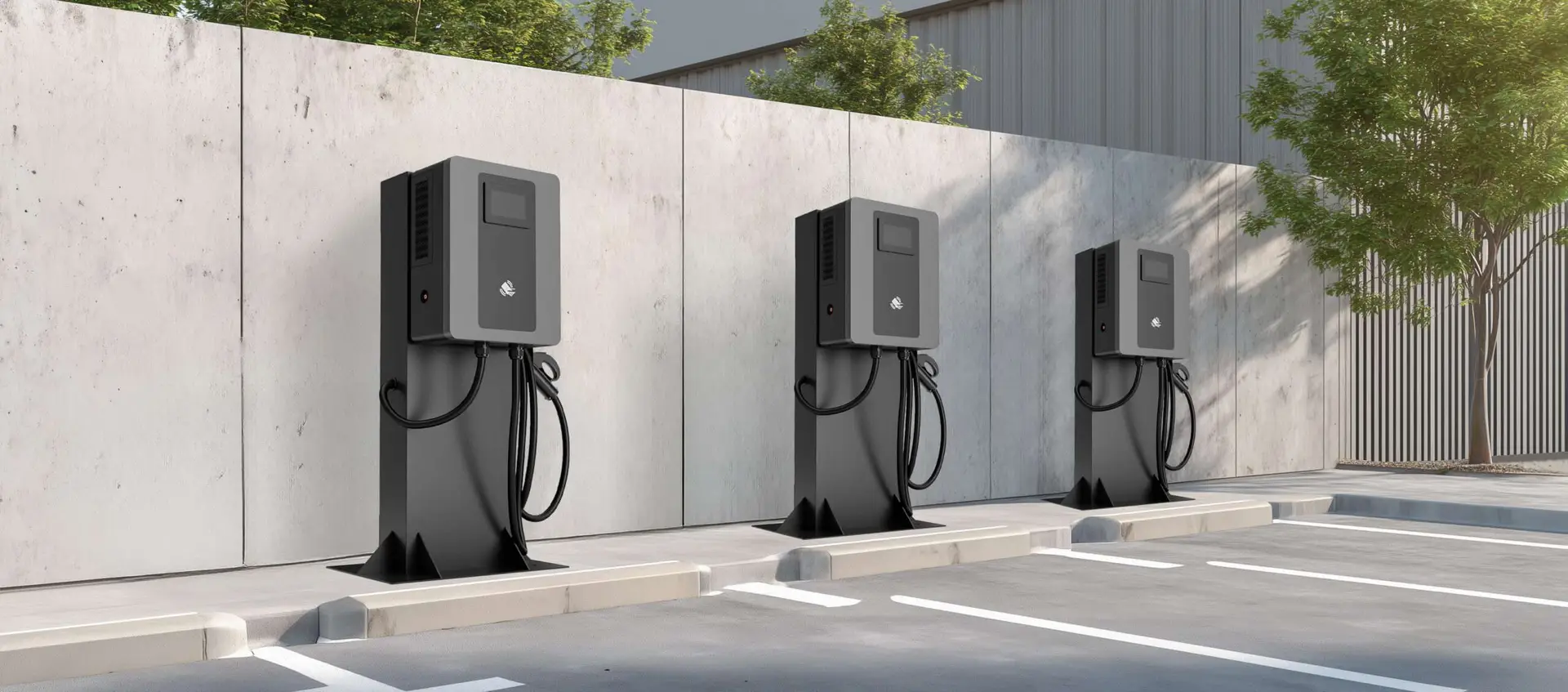
A 20-40kW DC fast charger is the most practical bridge between slow AC wallboxes and high-capital 120–240 kW charging cabinets. For retail centres, restaurants, auto dealerships, business parks, underground garages, and midday fleet depots, it delivers 20 to 40 kWh during a typical 1-hour stop while drawing only 42 A to 80 A per phase from an existing commercial three-phase supply. Operators avoid multi-month utility transformer upgrades, keep peak demand charges under control, and turn standard parking bays into reliable, higher-turnover charging assets.
Many commercial site owners assume EV charging is a binary choice: install inexpensive AC wallboxes or spend heavily on 120 kW+ highway cabinets. In practice, most commercial venues sit right in the middle. When drivers park for 45 to 150 minutes, an 11 kW AC unit often adds too little range to justify a paid session, while a 150 kW cabinet finishes charging before the customer leaves the restaurant and sits idle in the bay.
Where a 20-40kW DC fast charger fits best
Selecting commercial EV charging hardware starts with two site realities: how long vehicles stay parked and how much spare three-phase current sits in the existing distribution board. Unlike AC wallboxes, which rely on the vehicle’s onboard charger (frequently capped at 7 kW to 11 kW on passenger cars and light vans), a 20-40kW DC fast charger converts AC to DC inside the unit and feeds the battery directly.
That difference matters most wherever dwell time is too short for AC charging to deliver meaningful range, yet too long to justify a 120 kW+ cabinet. If you are weighing DC against AC across a mixed property, start with our ultimate guide to commercial DC fast charging or our commercial EV charging business case.
| Commercial Venue | Typical Dwell Time | Recommended DC Tier | Approx. 380 Vac Input Current | Why 20–40 kW Beats AC 11 kW and 120 kW DC |
|---|---|---|---|---|
| Supermarkets, retail parks & restaurants | 45 to 90 minutes | 30 kW or 40 kW | 60 A to 80 A / phase | Adds 20–35 kWh during one visit; avoids idle 120 kW hardware while customers dine |
| Auto dealerships & service workshops | 1 to 2 hours | 20 kW or 30 kW | 42 A to 60 A / phase | Rapidly tops up test-drive and handover vehicles inside tight service bays |
| Underground commercial garages | 1 to 3 hours | 20 kW or 30 kW (compact) | 42 A to 60 A / phase | Wall-mounted or compact footprint fits low ceilings and narrow driving aisles |
| Business parks & visitor car parks | 1.5 to 3 hours | 20 kW or 30 kW | 42 A to 60 A / phase | Serves visiting clients and sales reps who cannot wait 6 hours on AC |
| Hotels (dining, spa & conference guests) | 1.5 to 3 hours | 30 kW | 60 A / phase | Complements overnight AC bays by serving non-resident day guests |
| Light commercial & urban delivery depots | 45 to 120 minutes (midday) | 30 kW or 40 kW | 60 A to 80 A / phase | Gives vans a reliable midday range boost without triggering substation upgrades |
Consider a typical regional supermarket site in Europe with 120 parking spaces and an existing 400 A commercial building feed. Installing two 120 kW dual-gun cabinets would require roughly 256 kVA of supply capacity, forcing a new utility transformer and civil trenching. Deploying two 30 kW DC units instead draws roughly 60 A per phase each, fits inside existing panel headroom with basic load management, and delivers 22 to 28 kWh during a 50-minute weekly shop.
Commercial benefits and site economics of 20–40 kW DC
For property owners, Charge Point Operators (CPOs), and fleet managers, a mid-power DC fast charger improves project economics on both sides of the ledger: lower upfront capital expenditure and steadier monthly operating margins.
1. Lower grid upgrade and civil works CAPEX
High-power DC stations often spend more on transformers, switchgear, utility connection fees, and concrete plinths than on the chargers themselves. Because a 20 kW to 40 kW DC unit operates within 42 A to 80 A per phase on a 380 Vac three-phase feed (or 480 Vac in North America), electrical contractors can frequently tap an existing main distribution board. Shorter installation timelines mean the site starts generating revenue months earlier.
2. Higher bay turnover than AC wallboxes
On a standard commercial van or passenger EV with an 11 kW onboard charger, a 22 kW AC wallbox still delivers only 11 kW. A 30kW DC fast charger bypasses that bottleneck and charges at roughly 2.7 times the real speed of an 11 kW AC session. In a paid retail or visitor bay, faster energy delivery translates directly into more completed sessions per bay each day and a stronger reason for drivers to choose your location over a neighbouring car park.
3. Protection against utility demand charges
Commercial electricity tariffs typically combine an energy charge (per kWh) with a monthly demand charge (per kW) set by the single highest 15-minute power spike in the billing cycle. Research from the National Renewable Energy Laboratory (NREL) shows that demand charges can represent 30% to 70% of a commercial fast-charging electricity bill when utilisation is low to moderate. A single 150 kW session during an afternoon HVAC peak can erase an entire month of retail charging margin. Capping each port at 20 kW to 40 kW naturally flattens peak demand while keeping average utilisation high.
4. Stronger alignment with core venue revenue
In retail, dining, and hospitality, charging revenue is rarely the only commercial metric. When a 40 kW DC charger delivers roughly 25 to 35 kWh over a 45 to 60 minute meal or shopping trip, the charging curve matches the customer’s natural stay. Drivers neither abandon a charge half-finished nor rush out of the restaurant to avoid overstay penalties.
| Economic & Operational Metric | AC Wallbox (11–22 kW) | Mid-Power DC (20–40 kW) | High-Power DC (120–240 kW) |
|---|---|---|---|
| Typical energy delivered in 60 min* | ~7–11 kWh (OBC-limited) | ~18–38 kWh | Full 10–80% in 20–35 min (then idle) |
| Transformer upgrade likelihood | Very low | Low to moderate | High (often dedicated transformer) |
| Demand-charge exposure | Low | Moderate and manageable | High at low/medium utilisation |
| Bay turnover per 10-hour business day* | 1 to 2 vehicles | 4 to 7 vehicles | 8 to 15+ vehicles (highway sites) |
| Commercial payback profile | Fast on long-dwell sites | Balanced CAPEX + steady kWh volume | Requires high daily throughput |
*Example (assumptions, not a forecast): Assumes a 30 kW commercial DC bay at a retail or business park operating 10 hours per day, averaging 5 paid sessions of 22 kWh each (110 kWh/day, or roughly 3,300 kWh/month). Actual utilisation, vehicle acceptance rates, battery taper above 80% state of charge, and local electricity tariffs vary by site and must be modelled against local utility rate schedules.
For mixed fleet operations that combine overnight AC charging with midday DC top-ups, see our fleet depot EV charging sizing guide.
Six O&M challenges commercial operators face with 20–40 kW DC
Deploying mid-power DC hardware is only the first step. Once stations go live in underground car parks, retail forecourts, or dealership yards, operations and maintenance (O&M) teams consistently run into six practical challenges.
1. Tight garage clearances, impact risk, and thermal derating
Underground car parks and service workshops rarely have wide concrete islands for 150 kg floor cabinets. Bulky enclosures narrow driving lanes, invite bumper strikes, and trap exhaust air against basement walls. Because air-cooled DC modules generate waste heat during continuous operation, poor airflow or high summer ambient temperatures push cabinets above their +50 °C derating threshold, quietly slowing charging speeds and triggering customer complaints.
2. Weak cellular signal and payment drop-offs in basements
Many commercial mid-power DC units sit one or two levels below ground. Relying exclusively on a 4G modem in a concrete basement causes intermittent OCPP heartbeats, failed QR-code authorisations, and stuck sessions that require manual support calls. Every failed start erodes driver trust and drives up helpdesk cost per kWh.
3. Mixed vehicle voltage platforms and connector standards
Commercial parking sites and multi-brand dealerships serve everything from older 400 V passenger EVs and light electric vans to newer 800 V architectures. In export markets and mixed fleets, vehicles may also arrive with CCS2, CHAdeMO, or GB/T inlets. Chargers with narrow output voltage windows fail handshakes on low-voltage or high-voltage packs, leading to false “charger out of order” tickets.
4. Peak building load overlap and breaker trips
At a hotel, supermarket, or office building, EV charging shares the electrical service with HVAC chillers, kitchen loads, and lifts. Without scheduled power limits or load balancing, three or four 30 kW DC units starting together during late-afternoon peak hours can trip upstream breakers or trigger punitive utility demand tariffs. For a deeper technical look at feeder protection, read our dynamic load balancing EV charger guide.
5. Bay hogging after charging completes
Even on a 30 kW or 40 kW charger, a vehicle that reaches 80% or 100% state of charge and remains plugged in for another two hours blocks paying customers. Without automated idle-fee enforcement or clear on-screen session status, site staff end up policing parking bays manually.
6. Slow field diagnostics and closed-software lock-in
When a commercial DC unit faults on a weekend, sending a certified electrician to site solely to read an error code can cost more than a week of station revenue. Worse, hardware tied to a proprietary backend traps the operator with one software vendor, preventing tariff changes, roaming integration, or fleet-system migration later.
| O&M Challenge | Direct Business Impact | Engineering Spec to Verify Before Buying |
|---|---|---|
| Tight aisles & heat buildup | Vehicle collision damage; silent power derating | Compact footprint, IP54/IK10 housing, >94% efficiency, −25 °C to +50 °C rating |
| Basement 4G dead zones | Failed starts, lost revenue, high support tickets | Wired Ethernet (LAN) support alongside 4G + offline RFID capability |
| 400 V / 800 V vehicle mix | Handshake errors on commercial vans and newer EVs | Wide 150–1,000 Vdc output window and configurable connector options |
| Building peak load spikes | Breaker trips and 30–70% demand-charge surcharges | OCPP Smart Charging profiles + high power factor (PF >0.99) |
| Bay hogging | Falling daily kWh throughput per port | OCPP backend idle-fee billing + clear 7-inch status display |
| Costly site visits & lock-in | High maintenance OpEx and stranded hardware | Open OCPP protocol, remote fault telemetry, and direct factory RMA support |
How MAXGREEN solves 20–40 kW deployment and O&M challenges
MAXGREEN manufactures two dedicated mid-power DC platforms at our ISO 9001 facility in Foshan: the MG-A10 (20 / 30 / 40 kW) for public car parks, retail parks, and business hubs, and the MG-A11 (20 / 30 kW) with a space-saving footprint engineered specifically for underground garages and tight fleet depots.
1. Space-saving enclosures built for real commercial sites
The MG-A10 measures 650 × 500 × 230 mm (excluding holster) and weighs roughly 60 to 66 kg, allowing clean wall-mounted or compact pedestal installation without blocking traffic lanes. The MG-A11 trims the footprint further for low-clearance basements and narrow depot bays. Both platforms feature IP54 ingress protection and IK10 impact resistance (excluding the display and RFID module), operate across −25 °C to +50 °C (with controlled thermal derating above +50 °C), and include a 5-metre cable and physical emergency stop button.
2. High electrical efficiency and wide-voltage compatibility
Both MG-A10 and MG-A11 deliver a 150–1,000 Vdc output range with ±2% voltage and current precision, covering 400 V passenger EVs, light commercial vans, and 800 V architectures from a single hardware SKU. Peak conversion efficiency exceeds 94% at the optimal V/I operating point, reducing waste heat inside enclosed garages, while a power factor above 0.99 avoids utility reactive-power penalties. Full input protection (OVP, OPP, OTP, UVP, SPD) and output protection (SCP, OCP, OVP, LVP, OTP, plus IMD insulation monitoring) protect both building switchgear and connected vehicles.
3. Reliable basement connectivity and open OCPP control
To eliminate underground signal dropouts, MG-A11 prioritises wired LAN connectivity, while MG-A10 supports both 4G and LAN. Both units integrate a daylight-readable 7-inch LCD touchscreen and standard OCPP backend communication, giving CPOs and property owners full freedom to connect their preferred management software for automated tariffs, idle-fee policies, scheduled power caps, and remote fault monitoring. MG-A10 also supports RFID (ISO 14443A/B, ISO 15693, FeliCa Lite-S), 2D barcode, and mobile payment workflows. For more on open backend standards, see our OCPP 1.6J vs 2.0.1 buyer’s guide.
4. Direct factory engineering and predictable lifecycle support
Hardware reliability depends on the team behind it. MAXGREEN backs commercial DC deployments with 30+ factory technical support engineers, free pre-shipment OCPP sandbox testing so units arrive pre-configured for your backend, a 2-year charging station warranty, and RMA response within 2 working days. Standard in-stock models dispatch in 3 working days, while distributors and CPOs building a private-label network can specify OEM branding (logo, housing colour, packaging, and UI) with flexible low-MOQ ordering and a 25 to 30 working-day lead time.
| Specification | MAXGREEN MG-A10 (General Commercial) | MAXGREEN MG-A11 (Compact Garage & Depot) |
|---|---|---|
| Power options | 20 kW (42 A in / 66.7 A out) 30 kW (60 A in / 100 A out) 40 kW (80 A in / 133 A out) | 20 kW / 30 kW (space-saving compact design) |
| AC input | EU: 3P+N+PE 380 Vac (±10%), 50 Hz NA: 3P+N+PE 480 Vac (±10%), 60 Hz | EU: 3P+N+PE 380 Vac (±10%), 50 Hz NA: 3P+N+PE 480 Vac (±10%), 60 Hz |
| DC output voltage | 150–1,000 Vdc | 150–1,000 Vdc |
| Efficiency & power factor | >94% · PF >0.99 | >94% · PF >0.99 |
| Protection & environment | IP54 / IK10 (excl. screen & RFID) · −25 °C to +50 °C · IMD + E-stop | IP54 / IK10 (excl. screen & RFID) · −25 °C to +50 °C · IMD + E-stop |
| Connectivity & start modes | 4G + LAN · OCPP · 7″ touch · RFID / 2D barcode / mobile pay | LAN-focused · OCPP · 7″ touch |
| Connector standards | CCS, CHAdeMO, GB/T (configured per market) | CCS / regional standard per market |
| Dimensions & weight | 650 × 500 × 230 mm · ~60–66 kg · 5 m cable | Compact space-saving enclosure · 5 m cable |
| Best deployment fit | Public car parks, retail hubs, restaurants, business parks | Underground garages, dealership bays, tight fleet depots |
Regional compliance documentation and connector configurations are supplied per target market on request. Explore our full commercial EV chargers portfolio or review installation trade-offs in our commercial EV charger buying guide.
20–40 kW commercial DC fast charger FAQ
How fast does a 30 kW or 40 kW DC fast charger charge an EV?
At 30 kW, a commercial DC charger delivers roughly 25 to 30 kWh in one hour, adding about 125 to 150 km (75 to 95 miles) of range to a typical passenger EV or light van. A 40 kW unit delivers roughly 35 to 40 kWh per hour, assuming the vehicle battery sits below 80% state of charge and accepts full power.
Can an existing commercial building install a 20–40 kW DC charger without a new transformer?
In many cases, yes. A 20 kW unit draws up to 42 A per phase, a 30 kW unit draws 60 A, and a 40 kW unit draws 80 A on a 380 Vac three-phase supply. If your existing main panel has spare capacity, or if you apply OCPP power limits during building peak hours, you can often deploy without a new utility transformer. Always verify feeder headroom with a licensed electrical engineer.
How do operators prevent underground connectivity failures on 20–40 kW DC chargers?
Use wired Ethernet (LAN) rather than relying solely on cellular 4G in concrete basements, and pair OCPP connectivity with local RFID card authentication. MAXGREEN MG-A11 is built around LAN connectivity for underground garages, while MG-A10 offers both LAN and 4G.
Should a commercial site choose 22 kW AC or 30 kW DC?
Choose 22 kW AC where vehicles stay 4 to 12 hours and upfront cost per port is the main priority. Choose a 30 kW DC fast charger where dwell times are 45 minutes to 3 hours, because most EVs cap AC intake at 7 kW to 11 kW while accepting the full 30 kW over DC.
Key takeaways
- Match power to dwell time: A 20-40kW DC fast charger is purpose-built for 45-minute to 3-hour commercial stops, including retail, dining, dealerships, office visitors, underground garages, and midday fleet top-ups.
- Protect project economics: Moderate 42 A to 80 A three-phase input current avoids costly transformer upgrades and limits exposure to commercial utility demand charges.
- Engineer for O&M from day one: Solve basement signal loss with wired LAN, prevent vehicle handshake faults with 150–1,000 Vdc output, and eliminate vendor lock-in with open OCPP control.
- Choose the right enclosure: Deploy MG-A11 (20/30 kW) where underground clearance and aisle width are tight, and MG-A10 (20/30/40 kW) for public commercial car parks requiring 4G/LAN and multi-payment options.
- Verify lifecycle support: Confirm efficiency (>94%), power factor (>0.99), IP54/IK10 durability, pre-shipment OCPP testing, and fast factory RMA response before ordering.
Planning a 20–40 kW commercial DC rollout for retail car parks, underground garages, or a fleet depot? Share your target power tier, available three-phase current, and connector standard, then request factory pricing so our engineers can recommend the right MG-A10 or MG-A11 configuration.
Sources
- US DOE Alternative Fuels Data Center: Developing Infrastructure to Charge Electric Vehicles
- National Renewable Energy Laboratory (NREL): Electric Vehicle Infrastructure – Energy Estimation and Site Optimization Tool (EVI-EnSite)
- IEA, Global EV Outlook 2025: Electric Vehicle Charging
- Open Charge Alliance: Open Charge Point Protocol (OCPP)